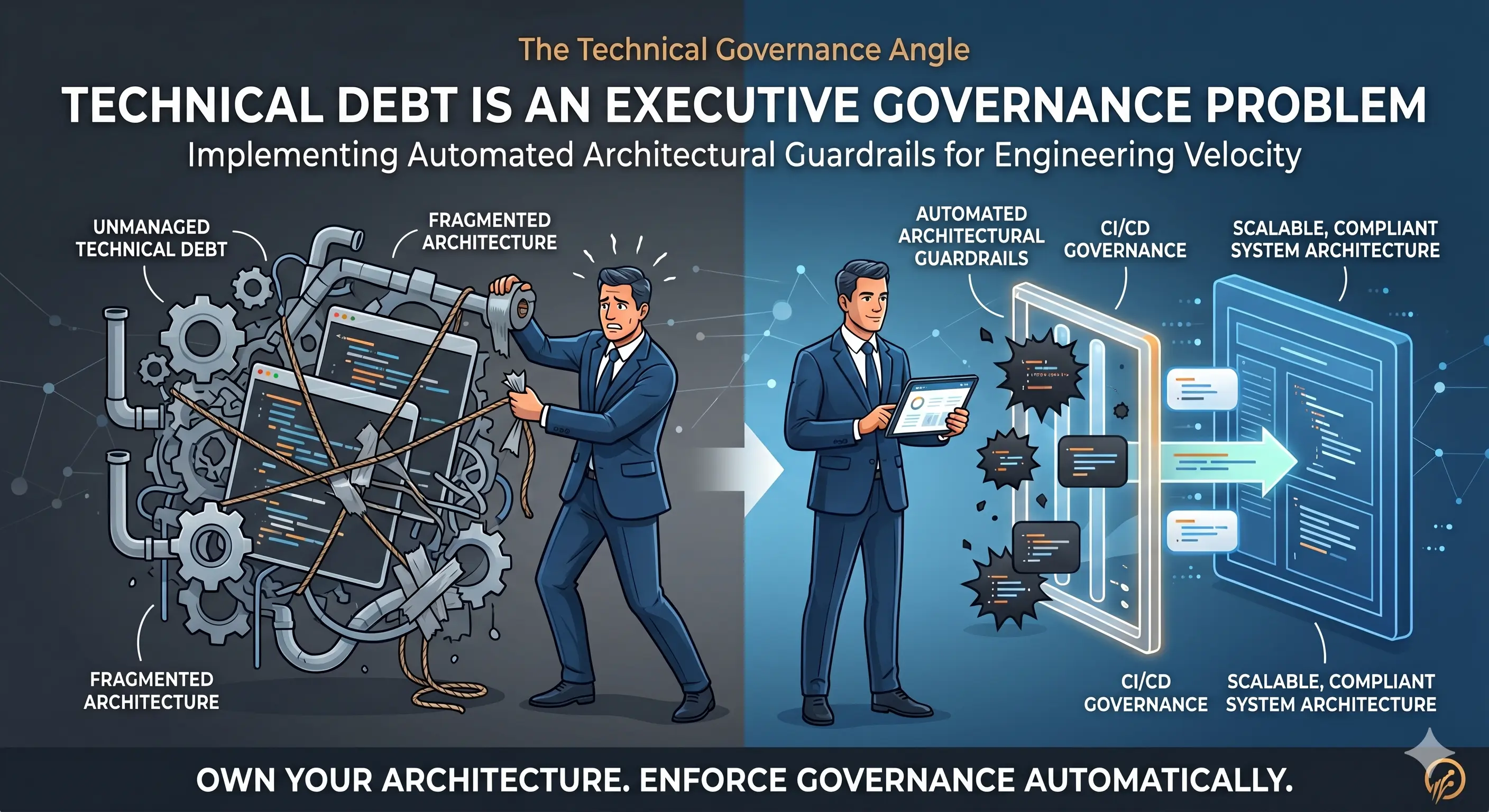
 Every engineering leader complains about technical debt. Remarkably few talk about how it actually gets introduced.
The convenient story is that engineers were careless, rushed, or undisciplined. In the codebases I audit, that's almost never the real cause. The debt accumulates because there are no structural guardrails — no layer of the system that makes the wrong decision hard and the right one automatic.
Technical debt, in other words, is rarely a code problem. It's a governance problem. And governance is an executive responsibility, not an engineering one.
How the Wild West actually forms
When teams scale rapidly, "move fast and break things" stops being a slogan and becomes the default operating model. Decisions that should be made once, centrally, get made repeatedly and inconsistently by whoever happens to be in the file that week.
In Python backends specifically, I see the same patterns over and over:
- Three different teams using three different ORMs or database abstraction layers — not because any of them was wrong, but because nobody owned the decision and no constraint prevented divergence.
- API endpoints shipped without strict Pydantic or OpenAPI contracts, so a routine backend change silently breaks a frontend client. The bug surfaces in production, usually late on a Friday.
- Type hints treated as optional, until a runtime
AttributeErrortakes down a service and turns into hours of debugging that static analysis would have caught in seconds.
Look at each of these in isolation and you'll be tempted to write a stern message about code quality. That's the trap. Every one of those choices was locally reasonable for the engineer who made it under deadline. The failure isn't individual. It's structural.
Governance is not bureaucracy
This is the point where most leadership conversations go wrong. The word "governance" conjures up review boards, sign-off chains, and process for its own sake — the exact things a good engineering culture is right to resist.
But real technical governance is the opposite of bureaucracy. Bureaucracy slows good engineers down with human gatekeeping. Governance removes the gate entirely by making non-compliance impossible to merge. The best version of it is nearly invisible: engineers don't follow the standard because they're disciplined; they follow it because the pipeline won't accept anything else.
The goal isn't to add friction. It's to move the friction from expensive human review to cheap, instant, automated feedback.
What automated architectural guardrails actually look like
Concretely, in a Python/cloud stack, governance lives in your CI/CD pipeline and looks like this:
- Formatting and linting as a hard gate, not a suggestion — so style is never a topic in a pull request again.
- Type checking as a blocking step. If the types don't hold, the build fails. Optionality is where the
AttributeErrorexplosions come from. - API contract enforcement. Schemas are validated and diffed automatically; a breaking change to a public contract fails the build before it can break a downstream client.
- Enforced module boundaries. Dependency rules — so the payments module physically cannot import from the internal guts of the auth module. Architecture you can draw on a whiteboard but can't violate in code.
- Architecture Decision Records (ADRs) for the decisions that genuinely can't be automated, so the why behind each standard is durable and survives team turnover.
Put together, these turn architectural intent into something the system enforces on its own — instead of something that depends on the most senior person noticing the problem in review.
The hidden cost of manual governance
When governance isn't automated, it doesn't disappear. It just gets paid for in your most expensive people's time.
I regularly see senior architects spending a large share of their review capacity on basic styling, naming, and structural patterns — the mechanical stuff — instead of on the work only they can do: designing scalable system topology and making the high-leverage architectural calls. That's not discipline. That's an organization burning its scarcest resource on problems a pipeline should be solving for free.
The question for engineering leaders
As your system and your team grow, the real question isn't whether you have standards. Most teams do, on a wiki somewhere. The question is whether those standards are enforced by tooling or by hope.
How does your engineering organization enforce architectural boundaries as it scales — through manual oversight, or through automated governance?
Linkedin pulse: technical-governance-angle-adaleo-research-development
At adaleo, this is exactly the layer we build: turning architectural intent into automated guardrails so your standards hold under pressure and your senior engineers get their time back. If your team is scaling faster than your governance, let's talk — I'm happy to walk through where we'd start.